
Jennifer Roback Morse February 04, 2026, at The Blaze
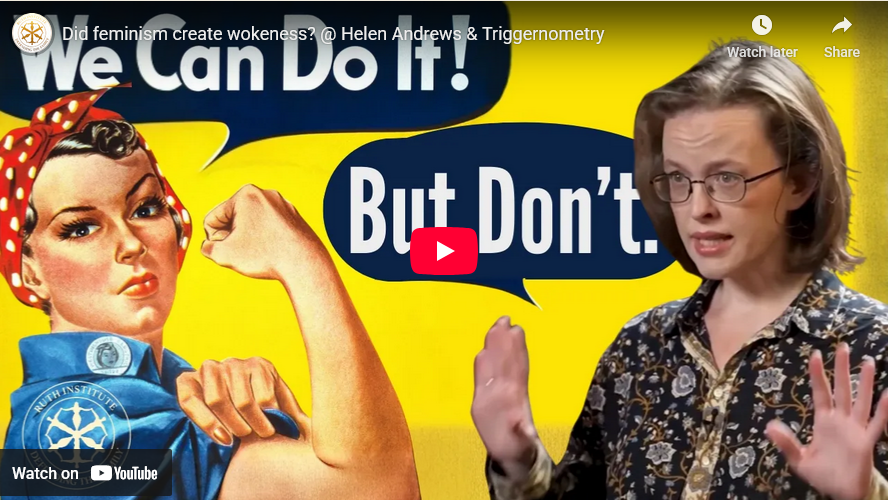
Helen Andrews’ ‘great feminization’ argument has a point, but the problem goes deeper.
Helen Andrews recently revived discussion of what she calls the great feminization — the idea that as women come to numerically dominate institutions, those institutions begin to function differently, often badly. Her observations are important and largely correct. What follows is a friendly amendment to her thesis. I agree with much of what she sees, but I think an essential part of the story still needs to be named.
Let’s begin by laying out her argument clearly.
The great feminization thesis
Men and women, on average, tend to behave differently. For our purposes, the key distinction is this: Women tend to prioritize relationships and consensus-building, while men tend to prioritize rules, justice, and abstract principles.
Helen Andrews puts it this way: Women ask, “How do we make everyone feel okay?” Men ask, “What are the rules, and what is just?”
If we borrow a familiar parental analogy: Mothers want children to be happy; fathers want children to behave.
The great feminization thesis makes two claims:
- When women numerically dominate an institution — whether a profession, a university, or a bureaucracy — that institution will naturally drift toward more “feminine” priorities.
- What we now call “wokeness” is simply the institutionalization of those priorities.
From this, Andrews draws a sobering conclusion: If wokeness is driven by demographics rather than ideology, it will not simply burn itself out or be defeated by better arguments.
That observation is serious, largely correct, and incomplete.
Key takeaway #1: Wokeness is not the point — totalitarianism is the point
Anyone who thinks wokeness began in 2020 is already naïve. What we now call wokeness is simply a recycled version of an ideology that has been circulating since at least the 1930s. We have called it communism, socialism, political correctness, multiculturalism — and now wokeness. Same garbage, different label.
The label is not the point. The content is.
These ideologies all promise the impossible: the end of poverty, the end of discrimination, the end of pollution, even the end of viral disease. When people talk this way, look out. They are asking for a blank check — unlimited moral permission to acquire power in pursuit of an unattainable goal.
Doing the impossible requires enormous power. Convincing people that it is not only possible, but a moral duty, requires propaganda. These ideologies don’t work for you or for society as a whole. They work for the people who are trying to accumulate power, while endlessly moving the goalposts.
So worrying about where “wokeness” begins or ends is a distraction. Totalitarian aspiration is the point.
Key takeaway #2: