A Reflection on Self-Reliance, Healing, and the New Year

“I believe I am the master of my fate. I am strong. I can do this on my own. I believe in myself.”
As a new year begins, phrases like these resurface on social media, in self-help books, in therapy spaces, and in well-meaning conversations about healing and growth. With January comes a wave of resolutions, fueled by passion and determination that, for many, quietly fades by Easter.
There is something beautiful about wanting a fresh start. The desire to heal, to grow, and to become better versions of ourselves is not wrong. Setting goals can be healthy and necessary, especially after seasons of pain. However, there is something beneath much of today’s mental health culture that deserves a closer look.
The Rise of Radical Self-Reliance in Healing Culture
Over the years, there has been an increasing emphasis on relying solely on oneself. We are encouraged to repeat positive affirmations, create vision boards, and “believe hard enough” that the life we want will materialize.
These tools are not inherently bad. Positive affirmations can help reframe negative thought patterns. Goals give direction. Visual reminders can be motivating. Yet, underneath many of these practices is an ideology that quietly places self at the center of everything. It suggests (often subtly) that God is irrelevant, unnecessary, or optional.
Manifesting Control: When Healing Becomes a Substitute for Trust
This is where the language of manifesting often enters the picture.
Some people believe they can bring their desires into reality simply by aligning their thoughts, beliefs, emotions, and “energy” with what they want whether that’s money, relationships, success, health, or happiness. If you focus hard enough, believe strongly enough, and stay “aligned,” the universe will respond.
This is not healthy.
When I Tried to Heal on my Own
I used to do a lot of “manifesting” without even realizing that’s what I was doing.
I believed that if I thought positively enough, spoke confidently enough, and envisioned success clearly enough, life would fall into place. I had a carefully curated vision board. It was organized, intentional, and filled with goals. Of course I wanted to heal, to be healthy, and I wanted a certain life, a certain future, and a certain sense of security.
In itself, having goals wasn’t wrong. After trauma, structure can feel stabilizing. Hope is necessary.
But looking back, I can see just how much I was relying on me, myself, and I.
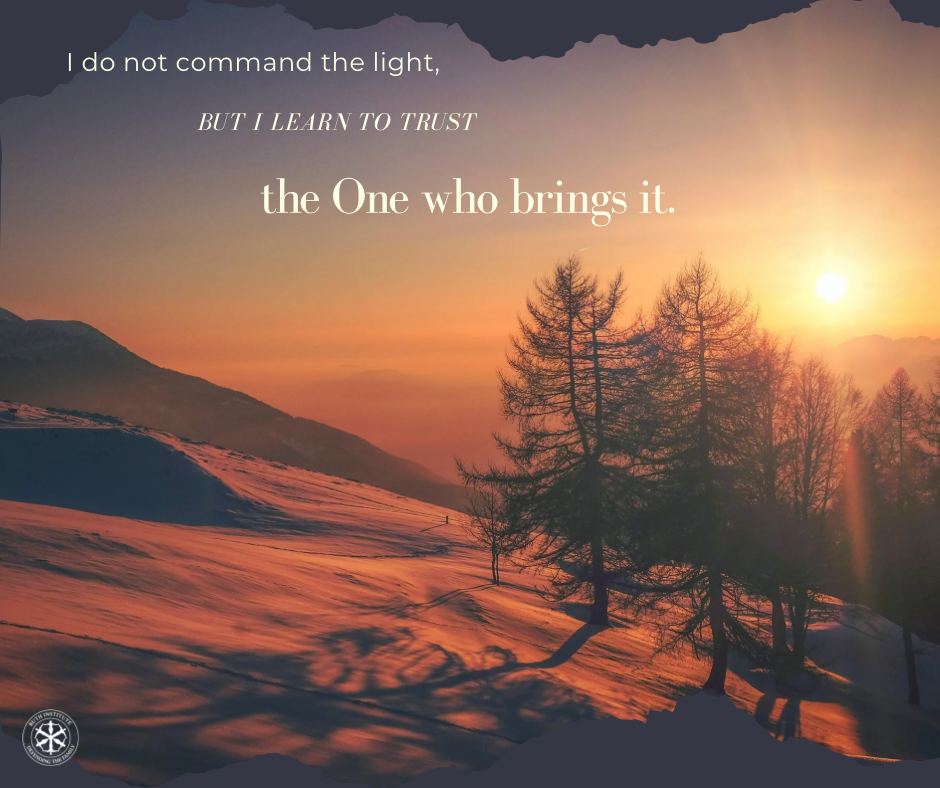
I rarely asked God what He wanted for my life. My prayers often consisted of telling God what I wanted and asking Him to make it happen. It took a long time (and a lot of humility) before I began to ask instead what He desired of me, and to surrender to His will, even when it included suffering, crosses, and uncertainty.
Fear, Trauma, and the Illusion of Control
If I’m honest, a great deal of my hesitation to trust God came from fear.
After living through profound pain, surrender felt dangerous. I didn’t fear God with reverence—I feared Him with distrust. I blamed Him for what had happened to me, and vulnerability felt unbearable. Trusting Him too much felt like setting myself up for more disappointment.
As a survivor, control often feels like safety. When so much has been stolen, the idea of being “the master of my fate” can feel empowering. Depending on self can feel safer than depending on anyone else, especially a God we cannot see with our eyes.
My background in criminal justice and psychology also played a role. There are truly wonderful therapists and social workers in this world. There are also deeply flawed systems and philosophies. Some modern mental-health ideas drift far from truth, far from God, and blur the line between healing and self-worship. I encountered both. For a time, the “new age” thinking seemed normal.
Why Self-Reliance Eventually Breaks Us
The truth is that radical self-reliance is exhausting.
It keeps our focus locked on this world, this life, and our ability to control outcomes. It subtly shifts our ultimate goal away from Heaven, away from holiness, away from surrender, and replaces it with personal success, comfort, and control.
That is not freedom.
Healing Should Include God, not Replace Him
If positive affirmations help you, use them. If vision boards help you clarify your hopes and goals, that’s fine. But also remember to pray.
Ask God what He desires for you. Invite Him into your plans. Resist the urge to tell Him what to do. Learn, slowly and imperfectly, to trust that His plan is better than yours even when it doesn’t make sense, and even when it turns everything upside down.
Surrendering to God is not weakness. It is an act of tremendous courage.
True healing does not come from believing we can do everything alone. Healing begins when we accept that we were never meant to carry our crosses by ourselves nor were we ever meant to have every detail of our lives perfectly mapped out.
A New Year’s Resolution Worth Making
This New Year, instead of declaring: “I am the master of my fate,” perhaps a better resolution is this: I am not alone, and I don’t have to carry it all by myself anymore. A prayer I say often comes from the Surrender Novena. “Jesus, I surrender myself to You. Take care of everything.” Perhaps you’ll find this helpful too.
Remember: whatever goals you set about to achieve, you are already loved and cherished by God. That doesn’t change!