

Every June, rainbow flags are hoisted high. Cities erupt in celebration. Schools, public libraries, corporations, and even some churches proudly join in what has become known as “Pride Month.”
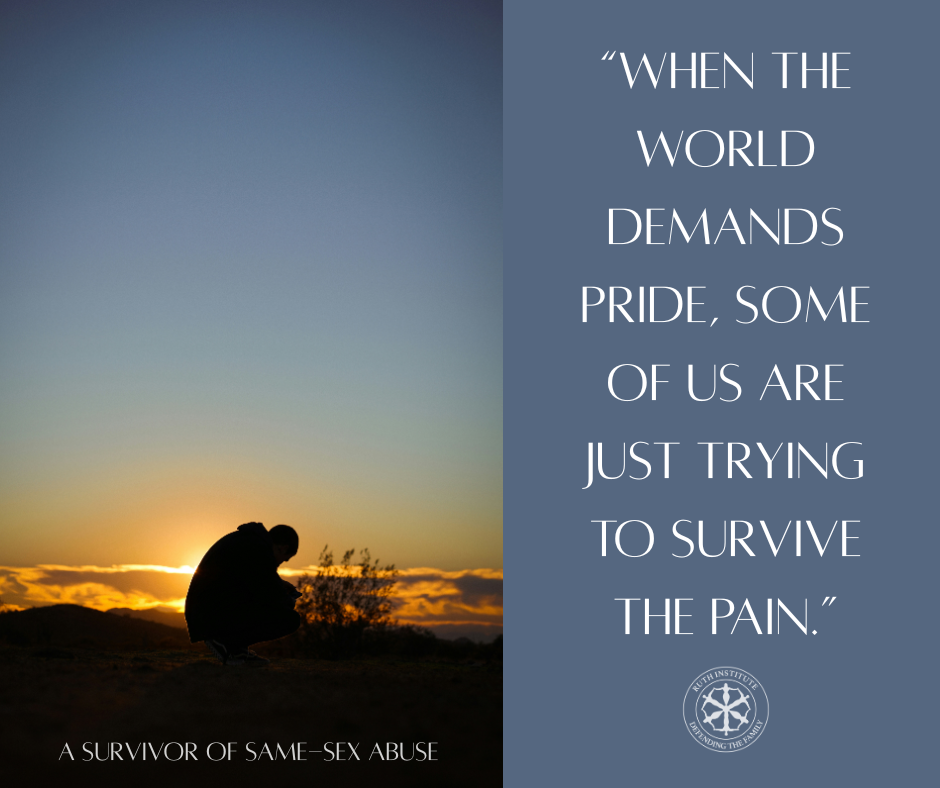
However, for many survivors of sexual abuse (especially those whose trauma involved same-sex assault) this month is not a celebration. It is a deeply painful reminder of a reality that much of our culture, and even parts of our Church, would rather ignore.
I recently heard from a man (a devout Catholic) who was sexually molested by another male during his childhood. His words struck a chord of truth and sorrow that cannot and must not be dismissed. With his permission, I share them here:
“As someone who was sexually molested by another male during my childhood, I speak not only from the authority of my faith, but also from the very real pain of lived experience. The month of June has been copted to ‘celebrate’ the LGBTQ lifestyle under the banner of pride, but this month is especially difficult for me, not just because of what I endured, but because of what our society and sadly, some in the Church have chosen to ignore.
Let’s be clear: Pride is one of the seven deadly sins and arguably, the gravest. When a culture chooses to glorify a disordered sexual ideology under the very name of sin itself, it is a mark of how far we have drifted from truth. As the Catechism of the Catholic Church plainly teaches:
CCC 2357: Homosexual acts are ‘intrinsically disordered.’
CCC 2358: Persons with same-sex attraction must be treated with ‘respect, compassion, and sensitivity.’
CCC 2359: They are called to chastity, as are all of us, according to our state in life.
These teachings are not optional. They are rooted in natural law, Sacred Scripture, and 2,000 years of unbroken moral theology. It is not ‘hateful’ to proclaim what the Church teaches; it is an act of charity to point souls to truth and salvation.”
This man’s pain is real, and it is magnified every time the very thing that caused his trauma is paraded as something to be proud of. The truth is, he is not alone. There are many who feel similarly and are suffering silently.
The Reality of Same-Sex Abuse
To some, this man might seem like the “wrong” kind of victim. Few want to acknowledge the reality of sexual abuse in general but especially same-sex sexual abuse. There’s an unspoken cultural script: men abuse women. That’s the narrative we’re more willing to hear. Even that comes with its share of stigmas. But men abusing boys or women abusers? That strays from “the norm.” That’s where many people turn away. The shame, the confusion, and the stigma are too much for society to confront. As a result, survivors like this man are often left in the shadows.
He is not a homosexual, but the hypersexualized nature of Pride Month, the graphic displays, the flag-waving, and the normalization of behaviors that so closely mirror his abuse all serves as a constant trigger. Disturbingly, he’s been forced by his employer to put up Pride flags each June. For years, he complied silently but with a heart full of grief and anger. By the grace of God, last year he found the courage to tell his supervisor why he couldn’t do it anymore. Thankfully, he was met with compassion. The question remains: why was it expected of him in the first place? Why were he and another Catholic co-worker the ones asked to do it?
This isn’t about hatred or bigotry. It’s about honesty and about recognizing that not everyone experiences June as a season of joy. Many carry deep, invisible wounds that are reopened by the culture’s distorted pride.
We Catholics are even sometimes told to “celebrate love” during Pride Month. Exactly what kind of love are we celebrating? True love, as the Church teaches, wills the good of the other.
As this brave survivor wrote to me:
“I grieve that many in our parishes, some of them people I worship beside, have become selectively catechized. They speak of love but forget that true love wills the good of the other. And the highest good is always eternal life, not earthly affirmation.”
He continues:
“I’m especially disturbed by leaders, even in positions of great authority such as Supreme Court Justice Ketanji Brown Jackson who could not define what a woman is. This isn’t politics; this is the erosion of reason and reality. As Romans 1:25 says, ‘They exchanged the truth about God for a lie, and worshiped and served the creature rather than the Creator.’”
Grief From Within the Church
One source of grief comes, not just from the culture, but from inside the Catholic Church itself.
It is deeply painful to see priests (most notably Fr. James Martin, SJ) offer public wishes for “Happy Pride Month” while ignoring the very real suffering of survivors (such as this man). When Fr. Martin claims that Catholics can “celebrate Pride” and attempts to reframe it as a celebration of “human dignity,” he dangerously distorts Catholic teaching. He downplays the seriousness of sin, dismisses the trauma many associate with Pride ideology, and gaslights those who raise sincere moral and pastoral concerns.
What’s worse, Fr. Martin’s message is often applauded by those who should know better, or it becomes a tool used to mislead the naive, the vulnerable, and the poorly catechized. It’s easy to embrace a message that aligns with one’s personal narrative, especially when it offers emotional comfort without moral challenge. For many so-called “cafeteria Catholics,” it’s far more difficult to accept the clear, unwavering truth spoken by priests and faithful witnesses who courageously address the seriousness of sins of the flesh. Sadly, how often do we even hear priests speak about these “big” issues—issues such as homosexuality, chastity, and purity? Far too many remain silent, fearful of offending, of being labeled, or of driving people away. Too many shy away from the “touchy subjects.” Silence does not serve the soul. Truth does.
As this survivor asked me: “Where is the dignity for survivors like me? Where is the dignity in lewd public displays, or in the use of children as props at pride parades? Where is the dignity in the aggressive silencing of those who have left the LGBTQ lifestyle behind and found healing and wholeness in Christ?“
To affirm disordered desires under the banner of “dignity” is not compassion. It is spiritual negligence.
Compassion Without Compromise
This is not just a personal or emotional matter for this survivor. It’s a professional one. He’s a law enforcement officer, a man who has dedicated his life to justice, truth, and the greater good. Every day, he sees the damage that cultural confusion causes especially for children and families.
“As someone who was once a child victim of that confusion,” he writes, “I cannot and will not stay silent.”
Silence, in this case, would be complicity.
We must never forget victims especially the ones the world finds inconvenient or uncomfortable. We must speak truth clearly and compassionately, even when it’s unpopular. As Catholics, we are called to walk the narrow road, not the wide and easy one.
“We must pray, fast, speak truth, and restore clarity beginning in our homes, our parishes, and our pulpits. And if that truth offends, then so be it. ‘You will know the truth, and the truth will set you free.’ (John 8:32)”
Let us not abandon our brothers and sisters who carry invisible crosses. Let us not affirm sin under the false guise of “love,” and let us remember that real compassion does not compromise with confusion. Real love and compassion speak with clarity, anchored in truth.
I close with one last quote from this brave survivor:
“God loves you, and He calls all of us to holiness and self-mastery, but affirming sin is not love. It is spiritual negligence. As Catholics, we must offer compassion without compromise.”