Same-Sex Parenting & Child Outcomes: What the Best Population Data Shows​

A synthesis of peer-reviewed research by Dr. Paul Sullins examining emotional, developmental, and mental health outcomes for children raised in same-sex parent households—using large, nationally representative datasets.

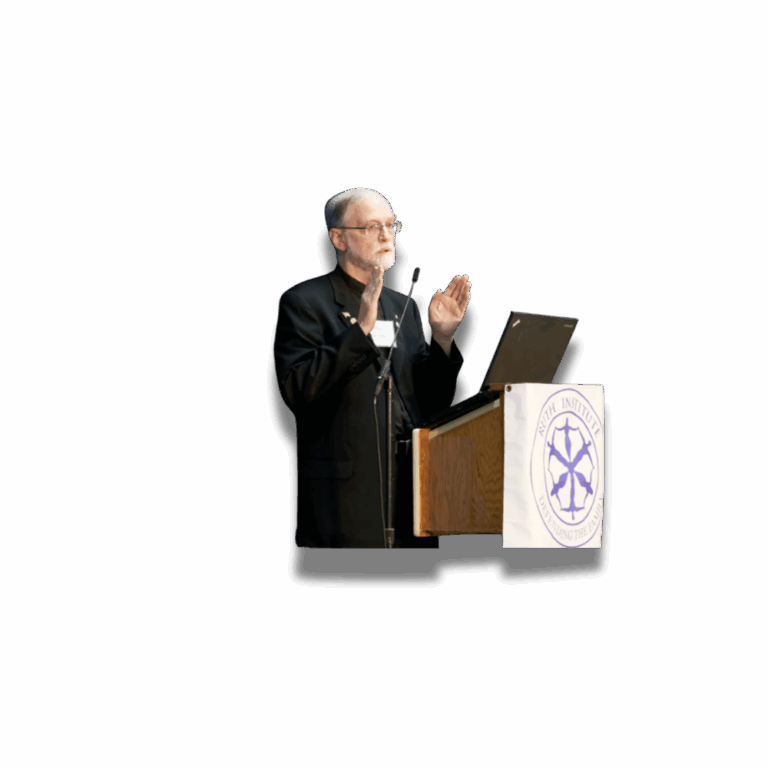
Rev. D. Paul Sullins, Ph.D.

“Scientific claims that cannot withstand even the slightest critical scrutiny are lionized by a sympathetic press and gullible public, while genuine scientific evidence for unpopular conclusions is systematically excluded from view.”

                                            — Dr. Paul Sullins, 2017 (Milan lecture)

FOLLOWING THE DATA

Public debate often claims there is a scientific consensus that children raised by same-sex parents experience “no differences” in outcomes.

Dr. Paul Sullins’ research critically re-examines that claim by prioritizing large population samples, transparent methodology, and replication of influential studies.

The findings raise serious questions about data quality, sample bias, and child well-being that are frequently absent from public summaries.


No. Large, nationally representative population studies consistently find higher rates of emotional problems among children raised by same-sex parents compared to those raised by married biological mother–father families. These include increased anxiety, emotional distress, and need for psychological services, even after controlling for income, education, and demographic factors. Source: Sullins, 2015 — Child Emotional Problems among Children with Same-Sex Parents

Generally, no. This analysis demonstrates that studies using recruited convenience samples consistently report favorable outcomes for children with same-sex parents, while studies using random population samples do not. The findings indicate that sample recruitment bias plays a major role in producing “no difference” conclusions. Source: Sullins, 2015 – Bias in Recruited Sample Research on Same-Sex Parenting

Key findings often fail to replicate. A replication and re-analysis of widely cited studies by Wainright and Patterson revealed substantial misclassification errors, including cases incorrectly identified as same-sex parent households. Once these errors are corrected and proper statistical methods applied, earlier conclusions of “no differences” are no longer supported. Source: Sullins, 2015 – Replication of Wainright & Patterson

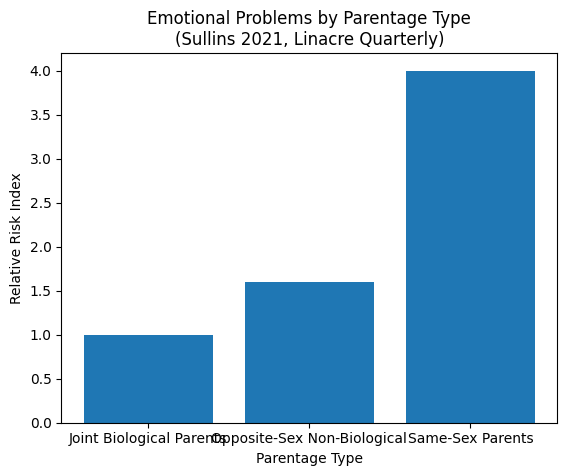
The presence of both biological parents. When marriage, stability, number of parents, and biological relatedness are analyzed together, joint biological parentage emerges as the strongest predictor of positive child outcomes. Children fare significantly worse when separated from their biological father than from their biological mother. Sullins, 2021 — The Case for Mom and Dad

WHY THIS RESEARCH MATTERS

CHILD OUTCOMES IN SAME-SEX PARENT HOUSEHOLDS: A RESEARCH ARCHIVE

This webpage serves as the central hub for the research of Dr. Paul Sullins on same-sex parenting and child outcomes. Drawing on large, nationally representative datasets, his work examines emotional, developmental, and mental health patterns among children raised in same-sex parent households—especially in comparison to children raised by married biological mother–father families.

Here you’ll find peer-reviewed studies, articles, and summaries that critically evaluate widely cited claims of “no differences” in outcomes. Each paper is accompanied by clear explanations of methodology, key findings, and direct access to full PDFs, allowing readers to assess the evidence and data quality for themselves.

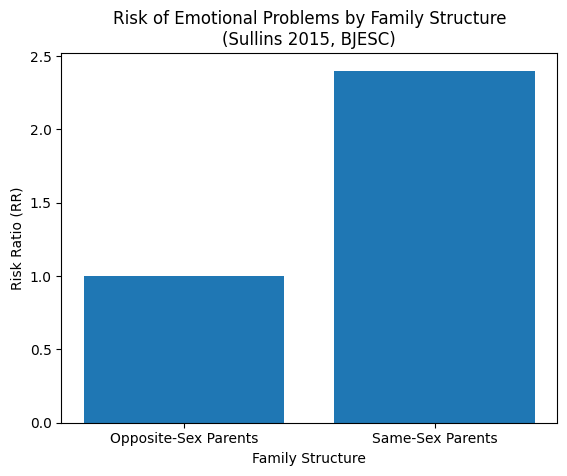
“Emotional problems were over twice as prevalent for children with same-sex parents than for children with opposite-sex parents.”

Dr. Paul Sullins (2015). Child Emotional Problems among Children with Same-Sex Parents


“Most of the adolescents classified as having same-sex parents were in fact living with opposite-sex parents.”


Dr. Paul Sullins (2015). The Unexpected Harm of Same-Sex Marriage: A Critical Appraisal, Replication and Re-analysis of Wainright and Patterson’s Studies of Adolescents with Same-Sex Parents


“Maximum child development occurs only in the persistent care of both of the child’s own biological parents.”


Dr. Paul Sullins (2021). The Case for Mom and Dad

– Dr. Paul Sullins

Explore Dr. Sullins' Groundbreaking Studies Below

Emotional Health Outcomes for Children with Same-Sex Parents
Using a large, nationally representative U.S. sample, this study finds significantly higher rates of emotional problems among children raised by same-sex parents compared to those raised by opposite-sex parents, even after controlling for socioeconomic factors.
READ FULL STUDY
Why “No Differences” Studies Often Get It Wrong
This methodological analysis shows that studies relying on recruited convenience samples consistently report favorable outcomes, while random population-based samples do not—demonstrating the role of sample bias in shaping conclusions.
READ THE STUDY
Data Errors in National Child Health Surveys
This Demography paper documents how classification errors in national survey data substantially distorted findings on children with same-sex married parents, leading to underestimated outcome differences.
READ THE STUDY

Academic & Public Response

What the Evidence Shows—and Why It’s Debated

For years, public summaries of the research have asserted that children raised by same-sex parents experience outcomes indistinguishable from those raised by married mother–father families. Dr. Paul Sullins’ work complicates that narrative by prioritizing large, population-based data and close examination of methodology—often reaching conclusions that differ from widely cited claims.

As a result, his research has been published in peer-reviewed journals while also generating debate and criticism, particularly from those invested in the prevailing “no differences” consensus. Regardless of response, these studies have expanded the scope of scholarly inquiry by drawing attention to questions of data quality, replication, and child well-being that are frequently absent from public discussion.

More Studies From The Research of Dr. Sullins

ADHD and Behavioral Risk in Same-Sex Parent Families
Analyzing over 200,000 U.S. households, this study finds that children with same-sex parents have more than double the prevalence of ADHD, along with elevated emotional and behavioral comorbidities.
READ FULL STUDY
Why Biological Parents Matter Most
When family structure variables are analyzed together, joint biological parentage emerges as the strongest predictor of positive child outcomes, outweighing marriage status, stability, or household composition.
READ THE STUDY
Adult Mental Health After Childhood in Same-Sex Parent Homes
This longitudinal analysis finds elevated rates of depression and psychological distress in adulthood among individuals who were raised by same-sex parents, suggesting that some mental health effects may emerge later in life rather than in childhood alone.
READ FULL STUDY
Responding to Criticism in Same-Sex Parenting Research
In response to published critiques, this article addresses methodological objections to findings on depression among adults with same-sex parents, clarifying sample definitions, analytic choices, and points of disagreement within the scholarly debate.
READ FULL STUDY

Featured MEdia

Playlist

6 Videos

What the Data Shows: Child Outcomes Across Family Structures

Risk of Emotional Problems by Family Structure

Child Emotional Problems among Children with Same-Sex Parents

Emotional Problems by Parentage Type

The Case for Mom and Dad

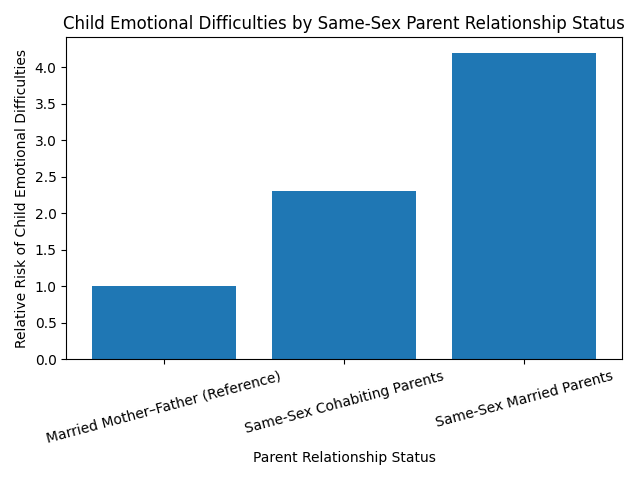
Marriage, Cohabitation, and Child Emotional Outcomes

This chart shows an unexpected and consistent pattern across multiple studies: among children raised by same-sex parents, emotional outcomes differ depending on whether the parents are married or cohabiting.

While children in both groups experience higher levels of emotional difficulties than those raised by married mother–father families, outcomes are consistently worse when same-sex parents are married to each other. This pattern appears across independent analyses and has been replicated by scholars who disagree with Dr. Sullins’ broader conclusions.

Source: Sullins, D. P. (2017). Sample Errors Call Into Question Conclusions Regarding Same-Sex Married Parents. Demography.

A Key and Often Overlooked Finding

Marriage and Child Outcomes in Same-Sex Parent Households

Research Archive


Bias in Recruited Sample Research on Children with Same-Sex Parents Using the Strengths and Difficulties Questionnaire (SDQ)
Sullins, D. P. (2015). Journal of Scientific Research & Reports

Child Emotional Problems among Children with Same-Sex Parents
Sullins, D. P. (2015). British Journal of Education, Society & Behavioural Science

The Unexpected Harm of Same-Sex Marriage: A Critical Appraisal, Replication and Re-analysis of Wainright and Patterson’s Studies of Adolescents with Same-Sex Parents
Sullins, D. P. (2015). British Journal of Education, Society & Behavioural Science

Invisible Victims: Delayed Onset Depression among Adults with Same-Sex Parents
Sullins, D. P. (2016). Depression Research and Treatment

Response to Comment on “Invisible Victims: Delayed Onset Depression among Adults with Same-Sex Parents”
Sullins, D. P. (2016). Depression Research and Treatment

Sample Errors Call Into Question Conclusions Regarding Same-Sex Married Parents
Sullins, D. P. (2017). Demography

Attention Deficit Hyperactivity Disorder (ADHD) and Emotional Problems among Children with Same-Sex Parents
Sullins, D. P. (2015). British Journal of Medicine & Medical Research

The Case for Mom and Dad
Sullins, D. P. (2021). The Linacre Quarterly

These studies by Dr. Paul Sullins examine child outcomes in same-sex parent households using large, population-based data and careful methodological analysis. Together, they raise important questions about widely accepted claims, highlight the role of family structure and biological parentage, and contribute to a more complete and transparent scientific conversation. We invite readers to explore the research directly and share it with others interested in evidence-based discussion.

Connect

The Ruth Institute is a 501c3 non-profit organization.

630 W. Prien Lake Road, Suite B #246, Lake Charles, LA 70601

© 2026 Ruth Institute