
This June, husband and I are celebrating 18 years of marriage. It’s been eighteen years of grace, growth, misunderstandings, healing, laughter, exhaustion, and the quiet daily decision to keep choosing one another over and over again. June is also the month the Catholic Church dedicates to the Sacred Heart of Jesus, which feels especially meaningful as I reflect on my marriage.
The Sacred Heart reminds us that authentic love looks is faithful, self-giving, steadfast, and merciful. It loves not only when love is easy, but also when it is costly. It remains present through joy and sorrow and through seasons of consolation and seasons of struggle.
That connection feels especially fitting when I think about marriage after sexual abuse. Most of you probably know that I am a survivor of clerical abuse. Marriage itself is a vocation of self-giving love, but trauma introduces a unique layer of reality into the relationship. For the spouse living with trauma, memories do not always stay in the past. Trust needs to be rebuilt slowly as the nervous system sometimes reacts before the mind has a chance to process what is happening.
I want survivors to know that it is absolutely possible to enter into a good, holy, and thriving marriage after abuse. However, trauma does add challenges that require intentionality, patience, communication, and grace from both husband and wife. These are lessons my husband and I have been learning together for the past eighteen years.
Marriage Learns How to Carry the Past
One of the earliest lessons my husband had to learn was simple but not easy: he could not “fix” what happened to me.
Most loving spouses want to remove the pain of their loved one. However, trauma cannot simply be solved. Rather, it needs to be carried, dealt with, and healed over time. In our early years of marriage, there were moments when my reactions confused him. There were moments when ordinary stress was misread as trauma, and moments when trauma was hidden behind what looked like ordinary stress.
We had to learn together to distinguish that not every hard day is a trigger, not every silence is a memory, and not every tear is the past intruding. Yet there are days when it is. That discernment took years. It required humility from both of us to ask, “What is really happening right now?” and humility to accept that sometimes the answer is complex.
One piece of advice we once received from a male survivor of clerical abuse has stayed with us: don’t assume every difficult moment is about the trauma. That single insight helped my husband stop over-interpreting my pain and helped me to allow myself to simply be human in ordinary struggles.
Your Spouse Can’t Rescue You
Your spouse is not meant to carry the weight of being your savior. No husband or wife has the ability to fulfill every longing of the human heart. Only God can do that, and strong marriages are built when both spouses recognize that only He can truly complete them.
I had to learn that even though my husband could not rescue me, he could become an important part of my healing. He could support me, cheer me on, and help me carry my cross. He could accompany me.
A spouse cannot be a therapist, a priest, or a savior. However, a spouse can be present, consistent, and willing to learn. In our marriage, that has meant learning when to speak and when to simply remain close. It has meant asking questions gently, knowing when to step back, and understanding that safety is often built in ordinary ways such as a calm tone of voice, predictability, sincere apologies, and the willingness to try again after failure.
Like all married couples, we had to learn one another’s patterns. My husband learned how to better understand my trauma, and I learned how to communicate what was happening inside me, even when I did not fully understand it myself. My husband became a steady presence I could rely on.
Healing Affects Both Spouses
Something that is often overlooked is that trauma does not only affect the survivor. Like it or not, it affects the marriage.
My husband had his own process of grappling with what had happened to me—anger, confusion, sorrow, and at times helplessness. There is a unique burden in loving someone who has been harmed, especially when that harm comes from a place that should have been safe.
My husband has had to bring his own pain to prayer, to conversation, and sometimes to counseling. There were moments when I had little to give him emotionally, and he still chose to remain steady.
Marriage after abuse requires both people to do their own interior work, and both to refuse the lie that only one person is “the one who needs healing.” A marriage is not one person coming into a relationship broken while the other simply carries them. Marriage is a man and woman, each with wounds and strengths, learning how to love and be transformed together.
Healthy Boundaries Allow Love to Thrive
Early in marriage, we had to learn that love requires boundaries.
Sometimes difficult conversations need to be paused and revisited later. Spouses also need to respect one another’s boundaries around physical intimacy and recognize that there may be limits to what either person can emotionally carry on a given day.
Boundaries are often what make intimacy possible without fear. Without boundaries, there is safety. That safety allows love to deepen.
Marriage Lived from the Heart of Christ
As a Catholic couple, my husband and I have learned over time that marriage is not sustained by our emotional intensity. It is sustained by God’s grace.
The Eucharist, prayer, and the sacramental life have become the foundation of our marriage. Every marriage passes through moments of strain and uncertainty. What remains steady is Christ.
In particular, devotion to the Sacred Heart of Jesus has taken on deeper meaning for us. The Sacred Heart is not distant from suffering. Rather, He enters into it fully and never abandons His beloved.
This matters especially for survivors like me, because abuse often distorts love itself. Healing is therefore both psychological and spiritual. It is the slow relearning that love can be safe, faithful, and not self-serving.
A good marriage bears witness to this reality in ordinary, daily ways.
Advice for Survivors Preparing for Marriage and for Married Couples
For those who are engaged or discerning marriage (especially if trauma is part of your story), and for couples already living this reality, here is some advice I would offer from my own lived experience:
- Choose someone who is willing to learn and grow with you.
- Don’t hide your story in the hope that it will make you more desirable. If someone is not willing to take on your crosses, then they may not be ready for marriage. You deserve to be known.
- Expect that healing will continue after marriage, but do not expect your spouse to carry what only grace can heal. They can accompany you, support you, and love you, but they cannot save you. Only God can do that.
- Marriage is not all about one person’s needs all the time. It is the union of two people, each with dignity, wounds, strengths, and responsibilities. Be willing to do your healing work, but also be willing to attend to your spouse’s needs. Love requires mutual self-gift, not comparison of suffering. A healthy marriage cannot function if one person becomes the sole center of emotional attention without reciprocity.
- It is also necessary at times to ask for help. Healing often requires community, counseling, and/or spiritual direction. A strong marriage is not one that carries everything alone, but one that knows when it needs support so that neither spouse is crushed by what is too heavy to bear.
- In daily life, it helps to learn discernment. Not every difficult moment is a trauma response, and not every strong emotional reaction is unrelated to it. Over time, couples begin to recognize patterns, but it takes patience not to over-interpret every struggle or reduce everything to the past.
- In moments of emotional overwhelm, simple language is often more helpful than long explanations. Simply asking, “Do you need space, reassurance, or silence right now?” can go a long way in providing safety, clarity, and presence.
- Healing is not linear. Even years into marriage, unexpected emotional aftershocks or triggers can surface. This does not mean failure or regression. It means something difficult has been touched, and it calls for gentleness and patience rather than alarm.
- Neither spouse is perfect. A loving spouse will still misunderstand at times, say the wrong thing, or miss what is needed in a moment. What matters is not perfection, but the ability to repair, apologize, and try again.
- For couples already married, it is also essential to keep returning to the basics: name what is happening when you can, learn the difference between “I need help” and “I need space,” and resist the assumption that every hard day has a single cause. Human beings are layered, and so is healing.
- Finally, keep returning to prayer, even when it feels dry or repetitive. Surrender your marriage to God. Sacramental life carries what emotion cannot. Learn to pray together, and pray for one another. And when you fail each other as all marriages do at times, return with honesty and humility. Try again.
Eighteen Years Later
Eighteen years later, I can say that marriage after abuse is not simple. However, it is possible, and it is beautiful.
It is possible to be known and still be loved. You can have a difficult history but still have hope. It is possible to struggle and still build something steady.
My husband and I don’t have a flawless marriage. No marriage is, but our marriage is faithful. That has required God’s grace.
As he and I enter our anniversary month under the gaze of the Sacred Heart, I am reminded that love is not proven by its ease, but by its perseverance. Christ loves our wounds and enters into them.
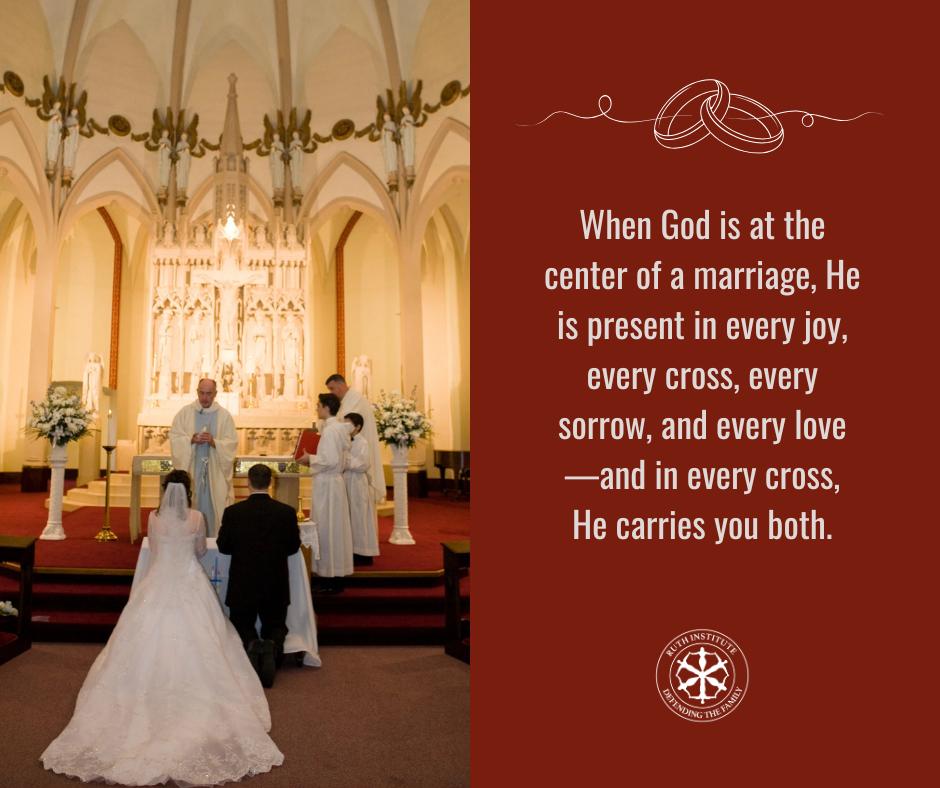
At our wedding, our priest held up a crucifix during his homily and said something that has stayed with us ever since: “You are my love, you are my cross, you are my joy.” At the time, I thought it was beautiful, but over the years, I have come to see how profoundly true it is in lived marriage. In a godly marriage, love, cross, and joy are not separate realities. They are bound together in Christ. Love is not diminished by the presence of the cross, because sacrificial love is itself a participation in the Cross. Joy is not the absence of suffering, but the fruit that grows when love is lived faithfully through it. My husband’s presence in my life has embodied all three. He is my love in companionship, my cross in shared burden, and my joy in the grace of persevering together through whatever comes.
That is the kind of love marriage is called to reflect—not perfectly, but honestly and patiently.